
Author: Dundalk FM
Page: 10

Seamus, Pat, Jamie, Pauline, Nicola, Caroline with facilitator Pat Byrne on Day 1 of the Community Radio course.
David Davies, Poetry, Landscape and Memory David Davies is in his mid thirties. He grew up in Clevedon, England, just across from Cardiff where his father was from. He lived there until he was ten years old. In 1991 his mother brought him back to her home in East Belfast. His father died at a young age, so David grew up without a father to help guide him through the culture shock that followed. During secondary school he was bullied and frequently told to “go back to England”. He attended Art College in Hull before returning to Castlereagh Art College in Belfast. In 2016 David published a book of poetry entitled The Romantic Landscape, inspired by what he describes as his favourite place in the world, the Mourne Mountains. David has performed at Mixed Jam and Purely Poetry events at the Sunflower Pub and Crescent Arts Centre in Belfast. This programme follows David Davies against the backdrop of twenty first century Belfast, poetry evenings, personal reflection, and the landscapes that continue to influence his writing. His voice is measured and his laugh sincere. The Long Woman’s Grave, Cooley Mountains The Long Woman’s Grave, Cooley Mountains. Recording at Dundalk FM Recording Normerella Blues at Dundalk FM studios. A Journey Through the Mourne Mountains Stopping for lunch in Newcastle before climbing Wee Binnian. Your browser does not support the audio element. The Mourne Wall read by David Davies while sitting at the summit of Wee Binnian, between Newcastle and Annalong, overlooking South County Down. Your browser does not support the audio element. Here is a draft edit for the programme entitled Fear Defined. As darkness falls and the landscape becomes quiet, Joni Mitchell paints a cloudlet in the evening sky. The Mourne Wall I feel the will to crawl Hiking along the Mourne Wall To cling and hug Sheltered from the winds bulk The wall is under no beck and call Its permanent fixture holds on Weighs down its granite anchor Hammers and chisels: tools for plug and feather Wraps around over twenty two miles of peaks Its dry stone is fitted with shape of preference A hope of a lasting fit It may have been to keep the sheep from getting lost It is where the heart is sparsely walked Inside its boundaries If the wall’s rocks could write It would be in between Where the wind blows through O hear those songs through the gaps And perhaps I think what shelter does the heart have? To starve it from risk; It is a bleak existence To be exposed with a threat of hyperthermia Even the wall’s defence The exploded battles of life Pummelled, rolled and battered Like a castle wall being knocked and fired at by boulders Its heavy blasts leave a devastation With collapsed rocks in piles It is now an opened wall Where sheep wander into the heart of its kingdom Roam freely, lost in memory From The Romantic Landscape David Davies Published by AuthorHouse, 2016 Welsh Translation Project We are sending a request to VCS Radio Cardiff 98.7 FM to see if a volunteer from the community radio station can translate a few lines of the poem for inclusion in the programme. Your browser does not support the audio element. David Davies and Alan Byrne at Omeath with the Mourne Mountains in the background. Research and Inspiration A visit to Belfast Library. Book Launch and Exhibition David launches his second poetry collection and displays his paintings at Holywood Arches Library, Belfast.
This series of programmes was presented by Dr Alison Lennon with primary students from Friary National School, Dundalk, Shelagh National School, Hackballscross, Scoil Naomh Lorcan, Omeath and St Clare’s Abbey, Newry, Co Down. Each show introduced pupils to the history and archaeology of their local area where they gained an appreciation and understanding of the heritage and landscape of their local community. Alison brought along artefacts such as arrowheads, coins and replica sword and shields. Part 1 Friary National School, Dundalk, Co Louth We learn about the archaeology of the area and the settlement of Dundalk by the Anglo-Normans in the late 12th century. the surnames of Anglo-Normans who settled here. Monuments: Seatown Castle, Roche Castle, Cuchullain’s Castle, the Proleek Dolmen, Cuchullain’s Stone and a number of local souterrains. Part 2 Scoil Naomh Lorcan, Omeath, Co Louth We learn about the archaeological artefacts found on the proposed site for Narrow Water bridge. This site, at Cornamucklagh, was excavated in 2013 and the remains of an early medieval industrial site was found as well as ‘burnt mounds’ dating from 7000 to 6000 BC. finds of an early medieval industrial site which includes two cereal drying kilns; a metalworking area; a series of pits of various sizes. This site is in close proximity to an early medieval monastery and these newly discovered features may be directly associated with this important ecclesiastical site. The finds also provide evidence of some form of Viking settlement in the area. the arrival of the Vikings in Ireland and the children talk about what the word ‘Viking’ means to them. Monuments: The Long Woman’s Grave, the Mass Rock in Ardaghy, Clontygora and Annaverna passage tombs. Part 3 St Clare’s Abbey, Newry, Co Down We learn about the association with St Patrick and how he gave the town its name ‘Lúr Cinn Trá’ – the Yew tree at the head of the strand (Newry). We learn about the first building constructed in the area, an ancient Christian monastery, which was replaced in 1144 by a Cistercian Abbey. the arrival of the Anglo-Normans in County Down. the ‘Crown Mound’, a very interesting motte and bailey castle, which is the largest in County Down and how it was built by the Mageniss’s (a local ‘native Irish’ family). Monuments: Newry Castle, Green Castle, Narrow Water Castle, Kilfeagan Dolman and Tamnaharry standing stone. Part 4 Shelagh National School, Hackballscross, County Louth We learn about the mythology of Slieve Gullion in relation to Fionn Mac Cumhaill and Cuchullain. the archaeological monuments found on Slieve Gullion, including its two burial cairns and passage tombs, one of which is the highest in Ireland. some of the artefacts found on Slieve Gullion. Monuments: Ballykeel Dolmen, the Killeavy Old Churches and Killnasaggart standing stone.
Programme 1 – Smoking The fifth edition of the Health Behaviour in School-Age Children in Ireland report shows a continuing drop in the number of Irish children smoking: since the initial report in the late nineties, each one has recorded a drop in the rate of smoking in 10-17 year olds – from 21.2% in 1998 to 11.9% in 2010 to 8% in 2014. However, while this is cause for celebration, it still means that one in ten of Irish children between the ages of 10 and 17 are smoking. This programme will examine how prevalent smoking is amongst young people in Dundalk and what type of cigarettes they are smoking (including packets of cigarettes, rolled cigarettes and vaping). It will feature a role play focusing on peer pressure. Contributors will include representatives from the Dundalk Youth Centre (which provides a supportive environment for young people, who are encouraged to express themselves through creativity and the arts), who will give his views on the problem of young people smoking and a representative from the Irish Cancer Society, who will discuss ‘X-Hale’, their initiative which aims to prevent young people from taking up smoking. There will also be an in-studio panel of young people, to get their views on smoking. Finally, we will here from the local Gardai about how the trade in counterfeit (and thus cheap) cigarettes can tempt young people into taking up smoking. Programme 2 – Alcohol Abuse A recent European School Project on Alcohol and other Drugs (ESPAD) report on teenage behaviour across Europe showed that Irish teenagers will binge drink more than their European counterparts. Half of all 15-16 year olds surveyed in Ireland said they had consumed alcohol in the previous 30 days, which is 7 per cent below the European average. But when asked how much they had drunk on their last drinking day, the survey showed that Irish teenagers drank significantly above the European norm (Irish teenagers consumed 6.7cl of pure alcohol and the EU norm was 5.1cl) This documentary will feature interviews with the organisers of junior (under 18) discos, to gain an insight into their day to day dealings with this problem. It will also include a discussion with a representative from the North Eastern Region Drug and Alcohol Task Force and from the Cox’s Demesne Youth and Community Project. As with each programme, their will be a panel discussion involving young people, both those who drink alcohol and those who don’t. Programme 3 – Drugs (Part 1) This programme will be split into two parts as the content is so large. A recent report by irishhealth.com states that; ‘It is not known how many people abuse drugs in Ireland and, of these, how many are adolescents. Opiate addition is, perhaps, the best documented, as users are more likely to have a need to present themselves for treatment. Over 7,000 people have attended the Drug Treatment centre in Dublin since it was founded in 1980. The first part of this programme will involve identifying the various types of illegal drugs being used by young people, included cannabis, cocaine and MDMA (ecstasy). Contributors will include representatives from organisations that are there to help tackle addiction such as the North Eastern Region Drug and representatives from the Alcohol Task Force and the Adolescent Addiction Service. An Garda Síochána have recently attempted to address this issue by patrolling the perimeter of local secondary schools to prevent drug dealers from targeting adolescents. We will have a representative from the Gardai to discuss the success of this initiatives. Finally we will have an in studio panel of young people, to get their views about the availability of drugs to young people and their awareness of the dangers of drug abuse. Programme 4 – Drugs (Part 2) The second programme on this issue will focus on the work of organisations trying to prevent the spread of drug abuse amongst teenagers. We will be examining school guidance and counselling programmes of various schools in Dundalk, as well as discussing their substance abuse policies. Contributors include representatives from the Positive Youth Education, a TY workshopthat works very closely with 1st Years to make them aware of the dangers of drug taking. Another contributor will be the local Youth Development Officer, who will talk about the problems being faced by him and his team with regards to drug abuse within local communities. Documentary 5 – Legal Highs In January of this year, Alex Ryan, 18, from Cork, died after reportedly snorting the drug ‘N-bomb’ (a legal high’ at a house party in Cork. Six young people were treated at hospital for taking the drug but Gardai believe Alex died because while the others swallowed this substance, he snorted it. N-Bombs (members of the NBOMe ‘family’ of drugs) are powerful hallucinogens, similar to LSD, which means they change the way you see objects and reality and often lead to hallucinations. The recent EU Drugs Markets Report 2016 emphasises the challenges Ireland is facing legislating for legal highs because new substances are being released faster than the government can ban them. The drugs are quickly made and easily disposable. When a ban is put in place on a particular drug, manufacturers are able to quickly replace it with another substance which is similar in effect but different in its chemical make-up – making it technically legal. A 2014 European Commission Report ‘Young People and Drugs’ stated that Ireland is the most common user of these drugs – with over 20% of 154 year olds surveyed saying that they had used “legal highs” at some point. Although the government banned ‘Head Shops’ in 2011, reports suggest that legal highs are still available, although they have now been pushed underground. This programme will explore how young people get hold of these products and look at their effects. Users of these substances will be given anonymity as we talk to them about their experiences. We will also examine the role of the internet in allowing young people to access these legal highs. Contributors will
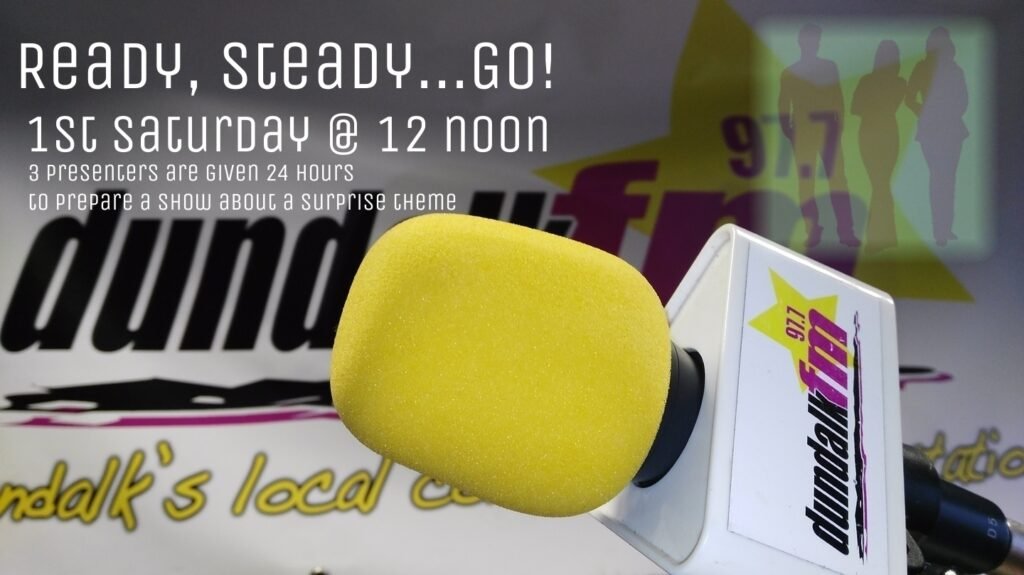
Ready Steady…Go! 28 July 2019 [podcast title=”RSG1 Part 1 Alvaro Lucchesi, Rory Moore & Tracey Hanby”]https://dundalkfm.ie/wp-content/uploads/2018/04/wRSG0180310-Alvaro-Lucchesi-Tracey-Hanby-Rory-Moore-Part-1.mp3[/podcast] [podcast title=”RSG1 Part 2 Alvaro Lucchesi Rory Moore & Tracey Hanby”]https://dundalkfm.ie/wp-content/uploads/2018/04/wRSG0180310-Alvaro-Lucchesi-Tracey-Hanby-Rory-Moore-Part.mp3[/podcast] [podcast title=”RSG2 Part 1 Karl Collins, Anita Guest & Kevin Larney”]https://dundalkfm.ie/wp-content/uploads/2018/04/wRSG0180324-Karl-Collins-Anita-Guest-Kevin-Larney-Part-1.mp3[/podcast] [podcast title=”RSG2 Part 2 Karl Collins, Anita Guest & Kevin Larney”]https://dundalkfm.ie/wp-content/uploads/2018/04/wRSG0180324-Karl-Collins-Anita-Guest-Kevin-Larney-Part.mp3[/podcast] [podcast title=”RSG3 Part 1 Marian Del Duca, Philip O Brien, Caoimhe O Malley and Tony Banda”]https://dundalkfm.ie/wp-content/uploads/2018/04/wRSG0180407-Marian-Del-Duca-Philip-O-Brien-Caoimhe-O-Malley-Tony-Banda-Part-1.mp3[/podcast] [podcast title=”RSG3 Part 2 Marian Del Duca, Philip O Brien, Caoimhe O Malley and Tony Banda”]https://dundalkfm.ie/wp-content/uploads/2018/04/wRSG0180407-Marian-Del-Duca-Philip-O-Brien-Caoimhe-O-Malley-Tony-Banda-Part.mp3[/podcast] Tony Banda: Hello Alan, just to say thanks for the opportunity to be part of the show, that was a great experience of roundtable on topics shared and I believe this will continue with interesting topics for the other shows to come. [podcast title=”RSG4 Part 1 Ciaran Callan Marissa Lucchesi Steven Jiminez”]https://dundalkfm.ie/wp-content/uploads/2018/04/wRSG40180428-Marissa-Lucchesi-Ciaran-Callan-Steven-Jiminez-Part-1.mp3[/podcast] [podcast title=”RSG4 Part 2 Ciaran Callan, marissa Lucchesi and Steven Jiminez”]https://dundalkfm.ie/wp-content/uploads/2018/04/wRSG40180428-Marissa-Lucchesi-Ciaran-Callan-Steven-Jiminez-Part.mp3[/podcast]
Living with the Border – an eight part Radio Documentary by Tom Brady. The Border is deeply symbolic and politically significant. But for those who live or have lived near the political boundary, it is a matter of ordinary efforts of dealing with its practical presence in everyday life. This became more difficult during the period of the troubles from early 1970’s to the mid-1990’s when crossing the border meant being subject to both Customs and Army or Police checkpoints. Paramilitary violence was at its height and there were casualties on all sides. Border crossing points were reduced, unapproved roads were blocked and watchtowers were erected. However daily life for the Border people had to go on, and the stories of the participants portray this in a light-hearted way. Living with the Border is a series of eight half-hour programmes documenting the life and times of people living and working along the border between the Republic of Ireland and Northern Ireland. Tom Brady’s shows are light-hearted but also capture fascinating stories from a broad section of people, particularly the unheard voices of farmers, business people, train drivers, public representatives and teachers who lived and worked both sides of the north Louth Border. How the border came into being. The Government of Ireland Act 1920 came into effect on 3rd May 1921 and provided for self-governing parliaments for Northern Ireland and Southern Ireland, thus partitioning Ireland. The Irish Treaty contained a provision that would establish a Boundary Commission, which could adjust the border as drawn up in 1920. A Tripartite Boundary Agreement was signed in December 1925 delineating the borderline. ‘Northern Ireland shall consist of the parliamentary counties of Antrim, Armagh, Down, Fermanagh, Londonderry and Tyrone, and the parliamentary boroughs of Belfast and Londonderry, and Southern Ireland shall consist of so much of Ireland as is not comprised within the said parliamentary counties and boroughs’. A Commission consisting of three persons, one to be appointed by the Government of the Irish Free State, one to be appointed by the Government of Northaern Ireland and one who shall be Chairman to be appointed by the British Government shall determine in accordance with the wishes of the inhabitants, so far as may be compatible with economic and geographic conditions, the boundaries between Northern Ireland and the rest of Ireland, and for the purposes of the Government of Ireland Act, 1920, and of this instrument, the boundary of Northern Ireland shall be such as may be determined by such Commission’. The border reshaped political and social realities across the entire island. For those who lived in close quarters with the border, partition was also a personal occurrence and implicated on everyday life. Mundane activities such as shopping, visiting families, travelling to church, farming (with some farms straddling the border), were often complicated by customs restrictions, checkpoints and cratered roads etc. The border cut off natural hinterlands, separated communities and neighbours that had lived together for years. While the hardships people suffered as a result of the border have been well documented, these programmes intend to look at the funnier side of living along the border. 1. Pat McCourt Pat is a former Businessman in Dundalk and his stories centre around his dealings with Catholics and Protestants across the Border. Prior to the troubles, bus loads of shoppers’ from Northern Ireland came to Dundalk to buy goods, especially on the 12th July, the day of Orange Marches in Northern Ireland. Pat served on the Dundalk Town Council and he will talk about Crowe Street incident in 1978. He attended funerals of those killed on blood Sunday on 13/1/1972 in Derry. He also talks about unapproved and approved roads in relation to the Customs and Excise work that he did. 2. John McGuinness John was a Bus Eireann driver on tours to Northern Ireland, before, during and after the troubles. The railway line at Kilnasaggart Bridge directly on the border was regularly bombed and he had to passengers from Dundalk to Newry and back by bus. He drove the bus across the border when other drivers refused. John drove his bus across the Border at the time when Judge Gibson and his wife were blown up in a bomb on the main Dundalk to Newry Road (he saw the smoke of the bomb). A mob in Dundalk tried to hijack the bus he was driving as they were on their way to attack Dundalk Garda Station in 1972 (the station was attacked and cars burnt and petrol bombs were thrown into the Garda Station). 3. Joe Mulligan Joe is a retired Principal Teacher of Sheelagh National School near Crossmaglen. The school in the Parish of Crossmaglen. Joe remembers what life was like as a teacher in a Border School, prior to, during and after the troubles. 4. Joe Quinn Joe had a shop in Hackballscross (next to Crossmaglen) for a number of years. He is native of Co Offaly and lived in America for a time. He is related to Brian Cowen, former Taoiseach. John moved to Hackballscross as his late wife was from the area. John will tell us about his first impressions on coming into contact with border, how currency fluctuations impacted his business, running two currency tills and his views on Brexit from EU. 5. Mona Daly Mona was brought up in the border town of Carrickmacross. Her father was a businessman and she recalls her memories of crossing the border with her father on business. Mona lives in Dundalk and she talks about what the realities of family life and how she feels the people of Dundalk and the area have a different outlook on life because of their experiences of checkpoints, low flying helicopters (go by in twos for safety), young armed soldiers, flags, identity and the fear of travelling into parts of the North etc. 6. Leonard Hatrick Leonard Hatrick lived in Ardee for 60 years emigrated to England in 1972 for a while
Irene Kane presents a 30-minute radio documentary entitled The History of the Automobile Association Ireland. The programme features interviews with Barry Kane, whose father was a patrolman between Drogheda and Dundalk and with Peter Connolly who is a retired AA Frontier Officer who worked near the Carrickarnon Customs post on the old Dundalk-Newry road. Peter Kavanagh reads a letter sent to Irene’s uncle Seamus Doherty who was also an AA Patrolman. The letter gives instructions for traveling to the AA Training School in Nottingham, England for a training course. The History of the Automobile Association in Ireland is presented by Irene Kane, recorded and edited by Alan Byrne with additional sound effects recorded by Pat Kane. Sent: Mon, 29 Jan 2018 21:25:43 +0000 Subject: Automobile Association Hi, I’m a regular listener to Dundalk FM. I live in London and find it keeps me in touch with home being formerly from Dundalk. I happened to be listening yesterday and there was a documentary on about The Automobile Association of Ireland. I found this not only interesting but extremely well presented and researched. Compliments to Irene Kane and all involved in this documentary. Keep up the great work. Kindest regards Donal Woods This programme was funded with the support of the Broadcasting Authority of Ireland with the Television Licence Fee. Background The Automobile Association was formed in London on 19th June 1905 to consider ways to overcome the perceived police oppression of early motorists and their use of speed-traps. The strategy they formed was to employ cycle scouts to patrol main roads and warn members of any police traps ahead. Initially, a motor cyclist and three pedal cyclists were recruited. The AA came to Ireland in 1910 and this documentary will look at how it evolved, narrating its early history and talking to people who worked for the AA. The programme will look at the history of the AA in Ireland. For centuries the ‘horse and cart’ was the only form of transport people had and it served them well. But now there was a revolutionary new invention called the motorcar. This was a huge advancement in transport, if you could afford to have one. But not everyone was in favour of this new invention because the motorcar travelled faster and it was noisy and created more dust on the roads. Some people even called them ‘horseless carriages’. Pressure was mounting on the police to curtail these speeding horseless carriages and so spawned the birth of the ‘Automobile Association’ better known to us as the ‘AA’. The AA was first established in Ireland in 1910. Their first meeting was held at No. 12 College Green in the centre of Dublin. Their three objectives were: to organise opposition to threats of Police Speed Restrictions to institute a system of Warning Signs and Directional Signs on our roads to take action to improve the dreadful state of the country’s roads Many of the older generation will remember the AA Patrol Man’s famous ‘Salute’. In the early years of motoring low speed limits were introduced along with speed traps to enforce them. The AA advised its members that their Patrols would warn of speed traps ahead by saluting motorcars with AA Badges displayed. The Authorities declared this to be illegal and ordered the AA to stop. The AA then proclaimed that their members motorcars would always be saluted unless there was a speed trap ahead and so they were able to continue to warn the motorist. This famous ‘salute’ continued to be used up to the mid 1960’s as a courtesy gesture to all AA members with Badges displayed on their vehicles. While the AA used bicycles initially they soon had their familiar yellow and black motorcycle/sidecar combination. These machines were widely used up until the 1960’s. The AA erected the first ever road signs to be seen in Ireland, amounting to 4,000 in the first year signs such as: ‘Road Closures due to Inclement Weather’ or ‘Drogheda 22 miles’ or signs to advertise ‘Forthcoming Events’. The AA held this responsibility for 40 years and many of these signs are still to be seen today. [podcast title=”The History of the Automobile Association in Ireland”]https://dundalkfm.ie/wp-content/uploads/2018/01/History-of-the-AA-in-Ireland-Webversion.mp3[/podcast]
Part 1 Part 2 In this programme Delores Whelan speaks to Dr Mary Condren who tells us about the importance of recovering the Divine Feminine into the narrative of our lives. Dr Alison Lennon brings us around the Graveyard at Faughart and talks about the Medieval church, and other artefacts including Brigid’s Well. Fr Tom Hamill tells us about the mindfulness that reflecting on the words and life of St Brigid evokes. At the St Brigids’s Stream, Maura Lennon, May Coyle and Delores have a conversation about Brigid, spirituality and sacredness and peacefulness of Faughart Shrine. There is music from Ann McDonald, Michael McHale and Lá Lugh. Festival Events include: Pilgrimage from Dundalk to Faughart and Exploring the Sacred Sites of Faughart Saturday 27thh January. Dr Sharon Blackie author of “If Women Rose Rooted “ lecture and forum exploring the need to reconnect with our native feminine wisdom. Various workshops including Creative Writing, Movement Medicine, Sound Healing, Circle Dance, Gardening, Healthy Food and Be the Change Celebration of Brigid in Song and Prayer with Carmel Boyle, Ann Mc Donald, Dolores Whelan, Fr. Tom Hamill on Lá Fheile Bhride, 1st February, The Oratory, Faughart. Day of Healing, 1st February, 1-8pm, Healing sessions in various modalities available. Brigid Cross Making with primary school children and adults. The Archaeology of Faughart. ‘The Wooing of the Soul’, a one woman play. Kate Fitzpatrick, author of “Macha’s Twins”, “Brigid, Culture and Transformation” Stories & Conversations for a Healthy and Resilient Culture facilitated by Davie Phillips. An Evening Weaving Poetry, Music and Song in An Tain Arts Centre. Closing Ritual, Ravensdale Community Centre, 4th February. You can find details of all the events and speakers by viewing or printing our Festival Programme on http://www.brigidoffaughart.ie/print-programme/ Le Beannachtaí Ó Brigid of Faughart Festival Team Contact: info@brigidoffaughart.ie.
Seoirse McCann promotes independent Irish rock and Indie Music by bands like The Minutes, The Bonnevilles, Empty Lungs, The Gakk, The Selections, New Valley Wolves,Fight Like Apes, Cult Called Man, Trucker Diablo, The Hot Sprockets, Bitch Falcon, Mindriot, Crow Black Chicken and Sons of Southern Ulster.